knest.ai • Property intelligence for home buyers
Dual Occupancy Explained (and How It Differs From a Duplex)
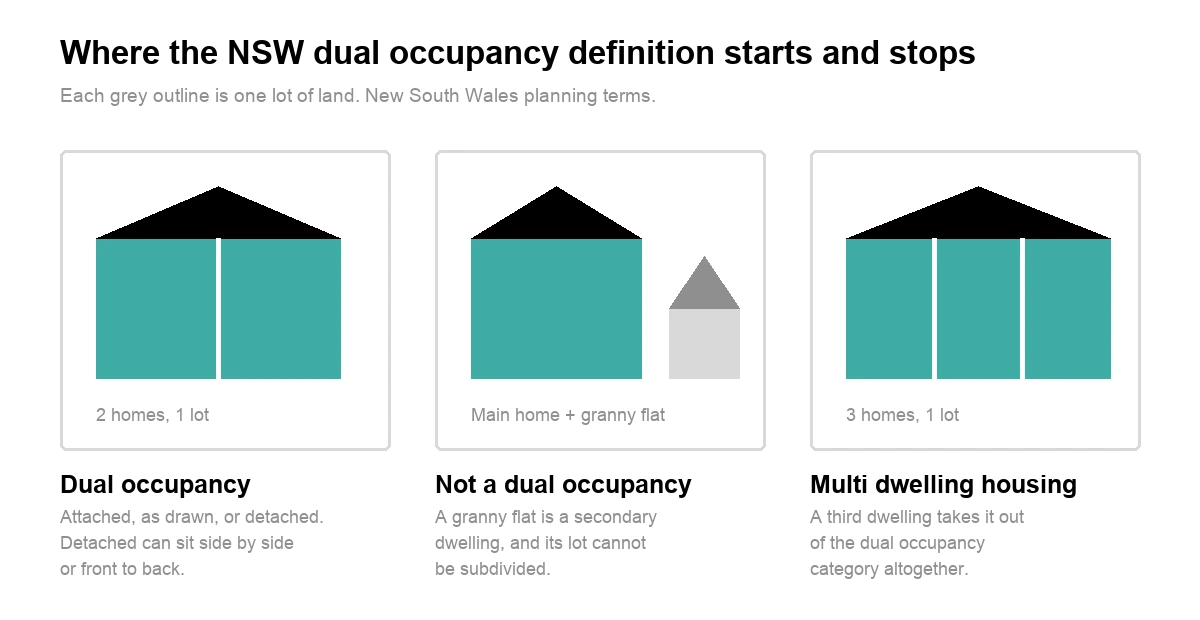
In New South Wales, a dual occupancy is two homes built on one lot of land. That is the whole definition, and almost everything buyers find confusing about the term sits in what it leaves out.
In New South Wales property, dual occupancy is a planning term: two homes built on one lot of land (NSW Department of Planning, Housing and Infrastructure, 2025).
The definition is simple. The important part is what it does — and does not — tell you. It separates a dual occupancy from a secondary dwelling such as a granny flat, and from multi dwelling housing with three or more homes. It does not tell you that the land has been subdivided, or that it can be. Those are separate questions, and the distinction matters when you are reading a listing.
- In New South Wales, a dual occupancy is two homes on one lot of land, and the state planning department says they can be “either attached or detached”.
- “Dual occupancy” is the planning word in New South Wales. “Duplex” is the market word, usually for the version that shares a wall, and the state planning department introduces it as the everyday name, not as a definition.
- A granny flat is not a dual occupancy under New South Wales planning rules, and its lot “cannot be subdivided”.
- Add a third dwelling to the lot in New South Wales and it stops being a dual occupancy at all. It becomes multi dwelling housing.
- In New South Wales, building two homes and subdividing the land are separate steps. A side-by-side dual occupancy is only a “semi” once the lot has actually been subdivided.
What does dual occupancy actually mean?
Two homes, one lot.
That is how the New South Wales Department of Planning, Housing and Infrastructure (2025) puts it, in a single line: “Dual occupancies are 2 homes built on one lot of land. The homes can be either attached or detached.” The second half of that sentence is the part people miss — in New South Wales, a dual occupancy does not have to share a wall.
You will also see it written as “dual occupancy homes”, or a “dual occupancy house”, mostly on builder and display-home sites. There the term may describe a housing product being marketed rather than the planning category a council assesses.
Attached, detached, and front-to-back
If you picture two homes sharing a wall, that is only half the definition. Two dwellings on one lot “that are attached to each other” is how the department (2025) describes the attached version. What characterises them is sharing “a common wall (also known as a partition wall) in a semi-detached configuration”.
Detached is the other half: “2 dwellings built on one lot that are not attached” (NSW Department of Planning, Housing and Infrastructure, 2025). Two separate buildings, one lot of land. They need not sit side by side either, and the department (2025) notes the dwellings “can be arranged either side-by-side or front-to-back”. So a house at the street with a second dwelling behind it can be a dual occupancy dwelling, which is not what the phrase suggests.
New South Wales also groups dual occupancy under low-rise housing, which it describes as “generally 1 to 2 storey” (NSW Department of Planning, Housing and Infrastructure, 2025). Read that as the department’s general characterisation of the category. It is not a height rule you can rely on for a specific block.
Where the definition stops
At the top, the boundary is clean. In New South Wales, three or more dwellings on one lot is “multi dwelling housing”, and each must have “access at ground level” (NSW Department of Planning, Housing and Infrastructure, 2025). A third dwelling therefore takes the property out of the dual occupancy category entirely, into the one that covers terraces and townhouses.
That boundary is worth knowing before you compare property types, and we work through the differences in our duplex vs townhouse comparison.
Dual occupancy vs duplex: what actually differs
In New South Wales the terms overlap but are not interchangeable. “Dual occupancy” is the planning category a council assesses a development against. “Duplex” is the market term, and the state’s planning documents connect the two by usage: dual occupancies are “often known as duplexes or semis” (NSW Department of Planning, Housing and Infrastructure, 2025). That wording is a translation, not a test.
The real difference is scope. A dual occupancy can be attached or detached, and “duplex” usually points at the attached form, the version sharing “a common wall (also known as a partition wall) in a semi-detached configuration”. So a listing that says duplex is describing a shape, while the New South Wales planning category also covers two detached homes on one lot.
The word’s reach also changes outside New South Wales, so don’t read the state’s definition across a border. The state-by-state picture is further down this guide, and for how “duplex” relates to title and ownership across Australia, see what a duplex is in Australia.
Dual occupancy, granny flat or subdivision?
These terms answer different questions. In New South Wales, dual occupancy and secondary dwelling describe what is developed on the land; subdivision is a separate question about whether the land itself has been divided.
A granny flat is not a dual occupancy
On granny flats, the New South Wales planning department (2025) is explicit: a dual occupancy excludes a secondary dwelling, which is the formal name for a granny flat. The definition is “a self-contained dwelling located within, attached to, or separate from another dwelling on the same site” (2025). So physical separation is not the distinction: a detached granny flat is still not a detached dual occupancy.
In New South Wales, “a lot on which a secondary dwelling is constructed cannot be subdivided” (NSW Department of Planning, Housing and Infrastructure, 2025), and developing one can “only result in there being one principal dwelling and one secondary dwelling on the site” (2025). So if a listing implies you could later split off the granny flat and sell it, treat that as a claim to verify.
In NSW, building two homes is not the same as splitting the land
In New South Wales, building two dwellings on one lot does not by itself turn that lot into two lots. The division is a separate step, and it ends in a subdivision certificate: one “must be obtained after subdivision works are completed”, and it is the instrument that “authorises the registration of the subdivision within NSW Land Registry Services” (NSW Planning Portal).
The state’s own vocabulary keeps the two facts apart. Semi-detached homes, the department (2025) explains, “are side-by-side dual occupancies that have been subdivided down the middle, so each house sits on its own lot”. The two dwellings and the two registered lots are separate facts, and a listing can be right about the first while the second has never happened.
Do not assume the consent that allowed two homes also splits the title. Check what has actually been approved and registered for the property, with your conveyancer or solicitor.
How is a dual occupancy approved in NSW?
Usually through a development application assessed by the council, and in narrower cases as complying development.
Under the New South Wales Low and Mid-Rise Housing Policy, dual occupancy is “permitted with consent in R2 zones state-wide”, and it may also be permitted in other zones under a council’s local environmental plan (NSW Department of Planning, Housing and Infrastructure, 2025). “Permitted with consent” does not mean automatic approval: most developments under the policy continue to require a development application assessed by the relevant council, and there are exceptions to the state-wide R2 position (2025).
Some dual occupancies can instead qualify as complying development. In New South Wales, dual occupancies “built as complying development are only allowed in R1, R2, R3 and RU5 zones”, and only “where this type of housing is already permitted under a council’s local environmental plan” (NSW Department of Planning, Housing and Infrastructure, 2026). Check the planning controls for the specific property before assuming either pathway is available.
If you are weighing an established dual occupancy against building one, see our guide to the cost of building a duplex.
Does “dual occupancy” mean the same thing across Australia?
No. The terminology changes at each border, and so do the boundaries of the categories. The words do not translate across state lines.
New South Wales uses “dual occupancy” as its planning term, attached or detached, as above — and its definition counts exactly two homes on one lot.
Brisbane City Plan also uses “dual occupancy”, but more broadly: it covers “2 dwellings on one lot (whether or not attached), or 2 dwellings on separate lots that share common property”. That second limb is not part of the New South Wales definition. And it is a Brisbane council definition, not a Queensland-wide rule.
The Australian Capital Territory defines the term statutorily: its Territory Plan dictionary sets “dual occupancy housing” as “the use of land that was originally used or leased for the purposes of single dwelling housing for two dwellings”, a type of multi-unit housing, which starts at “more than one dwelling” (ACT Government, Territory Plan 2023, Dictionary). The territory’s reform material groups these forms under “multi-occupancy housing”, “such as dual- and tri-occupancy housing” (ACT Environment, Planning and Sustainable Development Directorate).
Western Australia’s Residential Design Codes run their own category again: a “grouped dwelling” is “one of a group of two or more dwellings on the same lot”, generally with no dwelling stacked above another (Government of Western Australia, DPLH, 2024). The deeper comparison across states sits in our duplex guide.
Victoria, Tasmania, the Northern Territory and South Australia
The other four jurisdictions use different words and different boundaries. Victoria’s practice note on the residential provisions assesses by dwelling count, “two or more dwellings on a lot”, with no dual occupancy category (Victorian Government, PPN27). Tasmania’s State Planning Provisions use “multiple dwellings”, defined as “2 or more dwellings on a site”; “dual occupancy” appears nowhere in them. The Northern Territory’s planning scheme defines “dwelling-group”, two or more dwellings on the same site. And South Australia’s 2025 category is “co-located housing”, two or more community-titled dwellings inside a dedicated overlay (PlanSA, 2025).
Notice that the boundaries move with the words: New South Wales counts exactly two homes, Victoria, Tasmania and Western Australia group two or more, Brisbane reaches across lots, and the ACT attaches an origin condition of its own — land originally used for a single dwelling. If you are researching outside New South Wales, search the local planning term and check its definition, rather than assuming “dual occupancy” means the New South Wales version.
What this means if you’re buying a dual occupancy
Start by separating three questions: what has been built, what is registered on the title, and what could still be done with the land. A dual occupancy label does not answer all three.
The building may be visible or described in the listing. The title is a separate question: check what is actually registered, and have the documents reviewed by your conveyancer or solicitor rather than assuming that two homes mean two separately saleable lots. If a property is marketed as capable of being subdivided and sold separately, verify what has actually been approved and registered.
A granny flat needs particular care. In New South Wales, a lot containing a secondary dwelling cannot be subdivided.
The three questions therefore take different checks. Inspect the property to understand what has been built; read the title and contract to understand what is legally registered; and check the current planning controls and any required approvals to understand what may still be possible. Development potential is something you verify, not something the “dual occupancy” label gives you.
A knest.ai property report shows the site risks a listing leaves out: flood and bushfire exposure, zoning, power lines and noise. Zoning is also what decides what could be built on the block beside you.
View a sample reportFrequently asked questions
What is a dual occupancy?
In New South Wales, a dual occupancy is two homes built on one lot of land. The NSW Department of Planning, Housing and Infrastructure says the two homes “can be either attached or detached”, and that a detached pair can sit side by side or front to back. In New South Wales, three or more dwellings on the lot is a different category, called multi dwelling housing.
Is dual occupancy the same as a duplex?
In New South Wales they usually describe the same building. “Dual occupancy” is what a council assesses against. “Duplex” is what a listing calls it. The NSW Department of Planning, Housing and Infrastructure introduces duplexes as what dual occupancies are “often known as”. The planning term reaches wider, because it also covers two detached homes on one lot.
Is dual occupancy the same as subdivision?
No. In New South Wales, building two homes on a lot and dividing that lot into two are separate steps. The NSW Department of Planning, Housing and Infrastructure describes semi-detached homes as side-by-side dual occupancies “that have been subdivided down the middle”, which happens after the dwellings exist. A subdivision certificate is a further instrument again.
Is a granny flat a dual occupancy?
Not in New South Wales. The NSW Department of Planning, Housing and Infrastructure states that a dual occupancy does not include a secondary dwelling such as a granny flat. The reason is that a secondary dwelling must sit on the same lot as the main dwelling. The same department also states that a lot with a secondary dwelling on it cannot be subdivided.
What are the requirements for dual occupancy in NSW?
The NSW Department of Planning, Housing and Infrastructure says dual occupancy is “permitted with consent in R2 zones state-wide”, and may be permitted in other zones depending on the council’s local environmental plan. Permitted with consent means a council-assessed development application, not an automatic right, and there are real exceptions. The zone, the council’s own plan and the specific block all matter.
What does dual occupancy mean in Victoria?
Victoria doesn’t use the term in its residential provisions. The state’s own practice note frames residential assessment by dwelling count instead: “one dwelling on a lot or small second dwelling” under clause 54, and “two or more dwellings on a lot” under clause 55 (Victorian Government, PPN27). So a Victorian two-home project is assessed by its count, not by a dual occupancy category. Ask your council which control applies to a specific property.
Sources
-
NSW Department of Planning, Housing and Infrastructure, Unpacking low-rise housing, 21 February 2025, retrieved 2026-08-13, https://www.planning.nsw.gov.au/policy-and-legislation/housing/low-and-mid-rise-housing-policy/unpacking-low-rise-housing
-
NSW Department of Planning, Housing and Infrastructure, Secondary dwellings, 17 July 2025, retrieved 2026-08-13, https://www.planning.nsw.gov.au/the-planning-system/housing/housing-sepp/secondary-dwellings
-
NSW Department of Planning, Housing and Infrastructure, Frequently asked questions, Low and Mid-Rise Housing Policy, 17 December 2025, retrieved 2026-08-13, https://www.planning.nsw.gov.au/the-planning-system/housing/low-and-mid-rise-housing-policy/frequently-asked-questions
-
NSW Department of Planning, Housing and Infrastructure, Complying development, 26 June 2026, retrieved 2026-08-13, https://www.planning.nsw.gov.au/the-planning-system/development-assessment/planning-approval-pathways/complying-development
-
NSW Department of Planning, Housing and Infrastructure, Summary of key provisions, 21 March 2025, retrieved 2026-08-11, https://www.planning.nsw.gov.au/policy-and-legislation/housing/low-and-mid-rise-housing-policy/summary-of-key-provisions
-
NSW Planning Portal, Post Consent Certificates, undated, retrieved 2026-08-11, https://www.planningportal.nsw.gov.au/development-and-assessment/post-consent-certificates
-
Brisbane City Council, Dual occupancy, planning and building requirements, undated, retrieved 2026-08-11, https://www.brisbane.qld.gov.au/building-and-planning/getting-started-on-your-project/residential-projects/dual-occupancy
-
ACT Environment, Planning and Sustainable Development Directorate, Missing Middle Housing Reforms, undated, retrieved 2026-08-13, https://www.planning.act.gov.au/planning-priorities/missing-middle-housing-reforms
-
Victorian Government, Planning Practice Note 27: Understanding the residential development provisions, retrieved 2026-08-27, https://www.planning.vic.gov.au/guides-and-resources/guides/planning-practice-notes/understanding-the-residential-development-provisions
-
Tasmanian Planning Scheme, State Planning Provisions, consolidation effective 26 June 2024, retrieved 2026-08-27, https://www.stateplanning.tas.gov.au/__data/assets/pdf_file/0003/543036/Tasmanian-Planning-Scheme-State-Planning-Provisions-effective-26-June-2024.PDF
-
Northern Territory Government, NT Planning Scheme 2020, Schedule 2: Definitions, retrieved 2026-08-27, https://nt.gov.au/__data/assets/pdf_file/0008/914930/nt-planning-scheme-schedule-two-definitions.pdf
-
Government of South Australia (PlanSA), Co-located Housing How to Guide, September 2025, retrieved 2026-08-27, https://plan.sa.gov.au/__data/assets/pdf_file/0005/1551578/How-to-Guide-Co-located-Housing.pdf
-
Government of Western Australia (DPLH), Residential Design Codes Volume 1, March 2024 version, A1 Definitions, retrieved 2026-08-28, https://www.wa.gov.au/system/files/2024-07/r-codes-volume-1-2024-mar2024.pdf
-
ACT Government, Territory Plan 2023 (NI2023-540), Dictionary, retrieved 2026-08-28, https://www.legislation.act.gov.au/ni/2023-540/ signature: Daniel Ryan — Editor, Buyer Guides & Property, knest.ai disclaimer: General information only. This article is general information for Australian home buyers. It isn’t personal legal, financial, credit or tax advice, and it isn’t a property valuation. Planning rules differ by state, by territory and by council, and they change over time. Check your own situation with a licensed conveyancer or solicitor in the relevant state. knest.ai is an AI property-intelligence platform that supports buyer judgment. It isn’t a conveyancer, a solicitor or a legal service, and it doesn’t replace one.