knest.ai • Property intelligence for home buyers
What Is a Party Wall in Australia? Who Owns It, Who Pays
The wall down the middle of a duplex is the part the paperwork explains and the brochure does not. In NSW, one word on the plan decides whether you have a right to it.
You are standing in a duplex. A brick wall runs down the middle. You want to know what you own, what your neighbour owns, and who writes the cheque when it cracks. That answer lives in your title documents, not a product brochure, and it changes by state. Start from what a duplex is in Australia, then read the wall.
- A shared wall does not mean shared ownership. Where a New South Wales plan registered or recorded after 1 August 1996 shows the boundary running through a wall marked “party wall”, cross-easements of support arise automatically; “proposed party wall” creates nothing and records nothing.
- The UK Party Wall etc. Act 1996 has no force here. Its surveyors, notices and awards are English and Welsh machinery.
- A support right is not a repair rule. Of the regimes in this guide’s table, only Western Australia sets a statutory repair split; five of the eight legislate for building the wall, not fixing it.
- Queensland runs a different statutory structure, with support easements inside community titles schemes, so don’t carry the New South Wales two-halves model across the border.
- South Australia and the ACT define a party wall by what it does rather than by severed ownership, so the two-half-walls model is a New South Wales construction and not a national one.
What is a party wall, exactly?
It depends which state you are in: a wall that looks shared is not necessarily jointly owned.
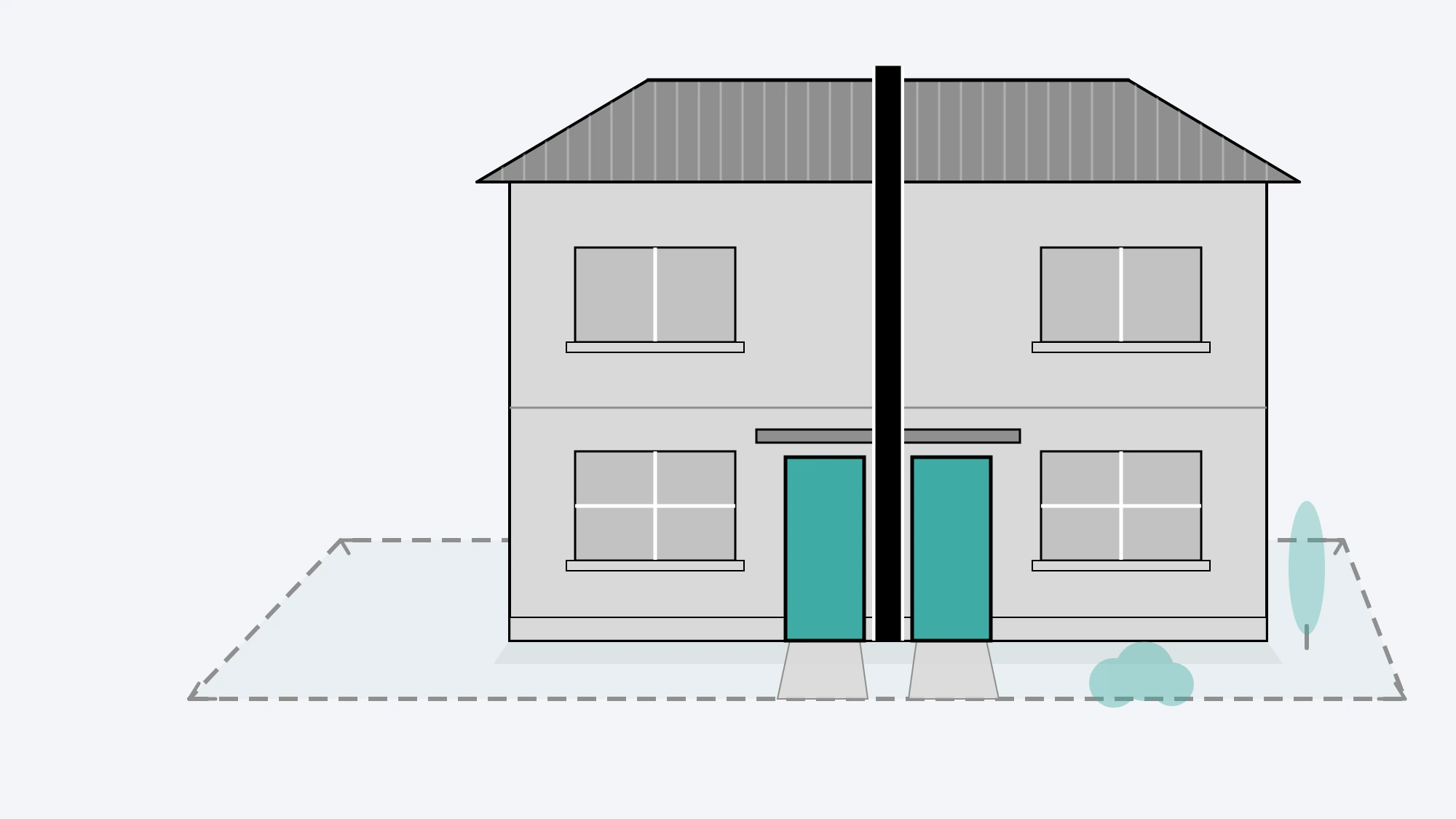
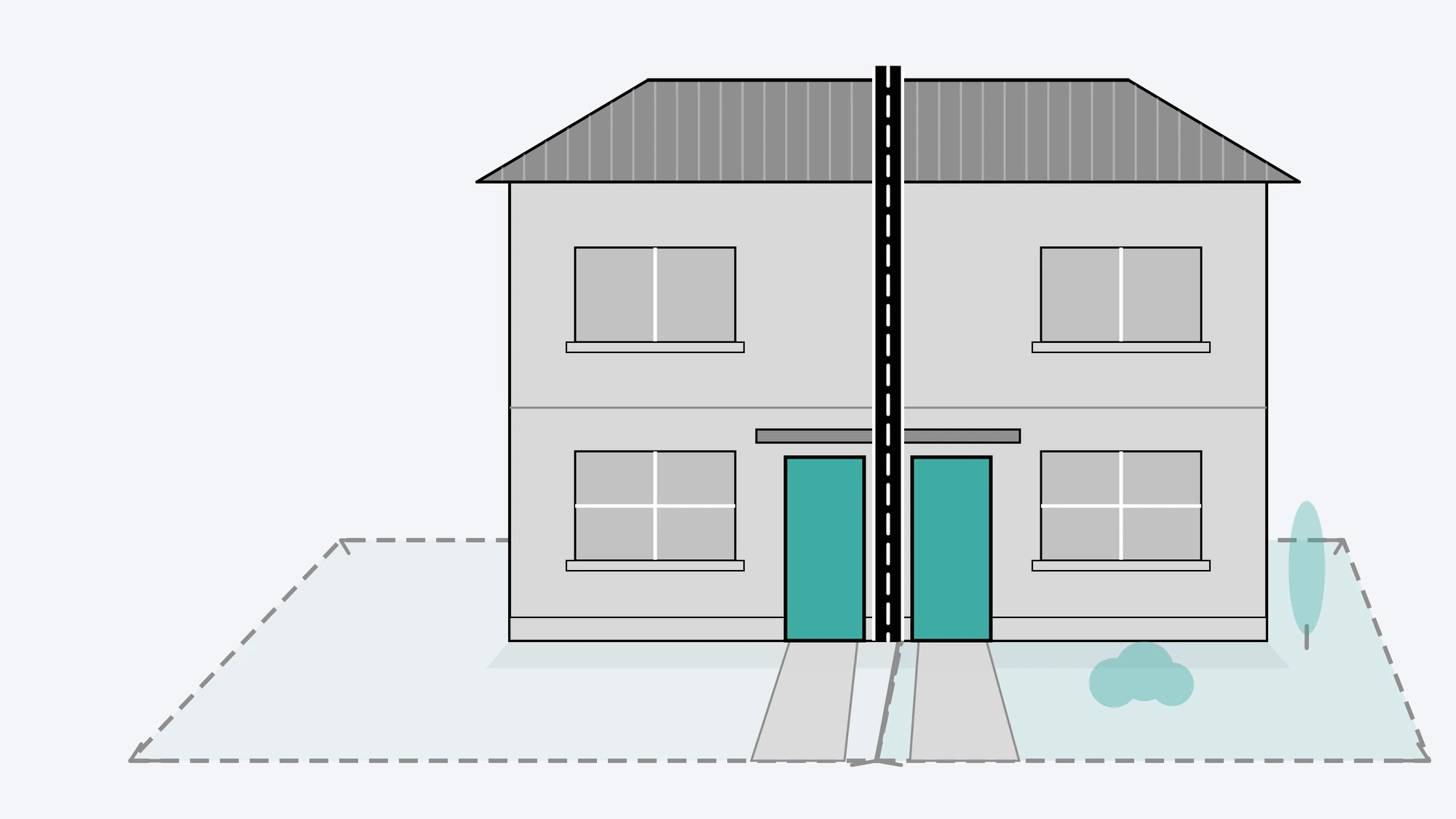
In New South Wales the phrase carries a statutory meaning, but which meaning depends on when the paperwork was done. Take an NSW deposited plan registered or recorded after 1 August 1996. It shows a boundary passing longitudinally through a wall “described in the plan as a ‘party wall’” (NSW Land Registry Services). The boundary runs through the wall. Each owner then owns the part on their land, and the cross-easements entitle each to rely on the whole of the wall for support.
Section 88BB creates those easements on registration of such a plan. Older arrangements ran on section 181B instead, through the assurance rather than the plan — the pre-1996 section below has the detail. Both routes end in the same picture; the instrument that produces it differs. The severance idea inverts the usual assumption: you own your half, and the easement protects your right to support from the other half.
Do the other states define it the same way?
No. Cross a border and the meaning shifts. South Australia and the ACT define a party wall by its function and position rather than by a title boundary severing it. South Australia covers a wall “built to separate 2 or more buildings”, or one on the dividing line between adjoining premises “for their common use”, and folds in Building Code common walls (Planning, Development and Infrastructure Act 2016 (SA), s 3); the ACT similarly reaches a structure “designed for the common use of 2 or more buildings” (Common Boundaries Act 1981 (ACT), s 27). Neither turns on severed ownership.
Western Australia fixes on position: a wall sitting wholly or partly on the boundary, serving a building each side (Building Act 2011 (WA), s 75). Queensland’s Land Title Act does not use the term at all; its support rights run instead through statutory easement provisions inside community titles schemes. So the NSW severed-ownership model is not a national definition. Reading the NSW model into an Adelaide or a Canberra purchase would send you looking in the wrong document.
Does the UK Party Wall Act apply in Australia?
No. Not in any state, not in either territory.
The Party Wall etc. Act 1996 governs England and Wales. Its statutory process runs on party wall notices, surveyors and party wall awards, and Australia does not use that framework. Party-wall rights and obligations here depend on the law of the relevant state or territory and, in some cases, the property’s title and registered easements.
The distinction matters because advice about party wall notices and party wall surveyors often relates to England and Wales, not Australia. If an online guide tells you to serve a party wall notice or appoint a party wall surveyor, check which jurisdiction it is describing before following it.
Does your duplex actually have a registered party wall?
In NSW you cannot tell from the wall itself. The deposited plan and the title records are where to start.
The Registrar General’s Guidelines published by NSW Land Registry Services are precise about how the right comes into being. A deposited plan registered or recorded in NSW after 1 August 1996 may show a boundary running lengthwise through a wall. Where that plan describes the wall as a “party wall”, cross-easements for support are created automatically under section 88BB. They are then recorded on the folios either side.
If those easements are not intended, or consents are missing, the plan shows the wall as a “proposed party wall” instead. In that case, the Guidelines state, “No notation will be entered on the folios of the Register.”
One adjective separates a right recorded against your title from no notation at all.
Read the register alongside the physical property, too: the easement is extinguished in law once the wall is demolished or stops supplying support, yet the entry remains until someone files to remove it, so a recorded right is not proof of a standing structure (NSW Land Registry Services).
What if an NSW plan predates 1996?
An NSW plan predating the 1996 rule cannot create the easement. For those older arrangements the position may depend instead on section 181B and the relevant transfer or conveyance rather than on the plan itself (Conveyancing Act 1919 (NSW), s 181B), and the Guidelines note that such a title may record that cross-easements “may apply”. That is a document-history question for your conveyancer, not something to infer from the age or look of the wall.
- Get the NSW deposited plan, not just the contract summary.
- Find the boundary line. It may pass through part of the structure of the wall, or run along the face of it, and either position can carry the easement.
- Read the exact wording. Look for “party wall”, and treat “proposed party wall” as a red flag.
- Note the plan’s registration date, before or after 1 August 1996, since that decides which rule applies.
- Ask your conveyancer to check the folio for a cross-easement notation or a section 88B instrument.
What if the plan says “proposed party wall”?
A “proposed party wall” notation does not prevent a cross-easement from being created later. Registered proprietors on either side may lodge a Request form 11R to have a cross-easement for support recorded, the Guidelines note. The notation on a plan marked “proposed party wall” exists precisely to make that later grant possible. Two conditions apply. Each relevant party has to consent, and the wall must be adequately defined in the plan (NSW Land Registry Services). For a buyer those are two separate questions: does a support easement exist now, and if not, what would creating one require? Your conveyancer or solicitor can settle the first from the title documents and explain the second — whether the neighbour would consent is a question only the neighbour can answer.
How the states and territories treat a shared wall
Which document you check changes as you cross a border, and the differences go beyond terminology: each jurisdiction may regulate ownership, support, consent and costs differently. Some run the rules through title law, others mainly through building work, consent or construction-cost machinery — so the table below puts the same three buyer questions to all eight.
| Jurisdiction | Governing instrument | What the law does for the wall | Does it set repair costs? | What a buyer checks |
|---|---|---|---|---|
| NSW | Conveyancing Act 1919, ss 88BB and 181B | Registered cross-easements of support, created by the plan or the assurance | No: the provisions cited here set no cost rule, for repair or construction | The deposited plan, for the words “party wall”, and the folio |
| VIC | Building Act 1993, ss 100 and 158 | Sends construction disputes to the Building Appeals Board, which decides each owner’s share | Construction cost only | No title notation: the process runs when work or a dispute arises |
| QLD | Land Title Act 1994, ss 115M and 115N | Statutory easements for lateral support and common wall support inside community titles schemes | Not framed as a cost split | The scheme plan: building format, volumetric format, or a standard format plan registered on or after 13 July 1997 |
| WA | Building Act 2011, ss 75, 79 and 89 | Defines the wall by position; consent required before work affects its structural, waterproofing or noise-insulation capacity | Yes: maintenance and repair in equal proportions, unless otherwise agreed | No title notation: consent arises when work is proposed |
| SA | Planning, Development and Infrastructure Act 2016, s 147 | Notice to the adjoining owner and written consent before a party wall is built; easements of support must be created and registered | Cost of building the wall, in proportion to likely use | The title: s 147 requires registered easements of support over both lots |
| TAS | Building Act 2016, s 56 | Consent, written agreement, and a registered easement instrument agreed by both parties | Construction cost, as agreed in writing | The registered easement of support instrument |
| ACT | Common Boundaries Act 1981, ss 27 and 28 | Defines the wall by common use; erection costs split by agreement, or set by the planning authority with an allowance for depreciation | Cost of erection only | The building approval under the Building Act 2004 |
| NT | Building Act 1993, ss 19 and 97 | Protection regime preserving party-wall easements; construction disputes go to a Board | Construction cost, Board determines the expenses | No title notation: the rule surfaces on a Board determination |
Who pays when the wall fails?
In Western Australia, the owners on either side, in equal shares unless they agree otherwise. Everywhere else in the table, no provision sets a repair split — several of the other regimes deal with the cost of building the wall, not the cost of repairing it later — so the answer comes from the title, any agreement between the owners, and your insurance.
New South Wales sets no statutory cost rule. Sections 88BB and 181B create an easement of support, which is a right to its continued existence. It is not a maintenance obligation, and it is not a formula for dividing a repair bill. That means the NSW support easement does not itself answer who must pay for later repairs.
Move west, and Western Australia does address repairs directly. Where a party wall needs maintenance or repair, each owner on either side is liable to contribute in equal proportions, unless otherwise agreed (Building Act 2011 (WA), s 89(2)).
South Australia divides the cost of building the wall in proportion to expected use (Legal Services Commission of South Australia). The ACT deals with the cost of erection, and if the two sides cannot agree, the territory planning authority sets the proportions and allows for depreciation. Tasmania requires the split to be settled in writing before building starts. Victoria and the Northern Territory send construction disputes to a Building Appeals Board. None of those five provisions sets a general formula for allocating the cost of later party-wall repairs.
What if the two duplex halves are on separate Torrens lots?
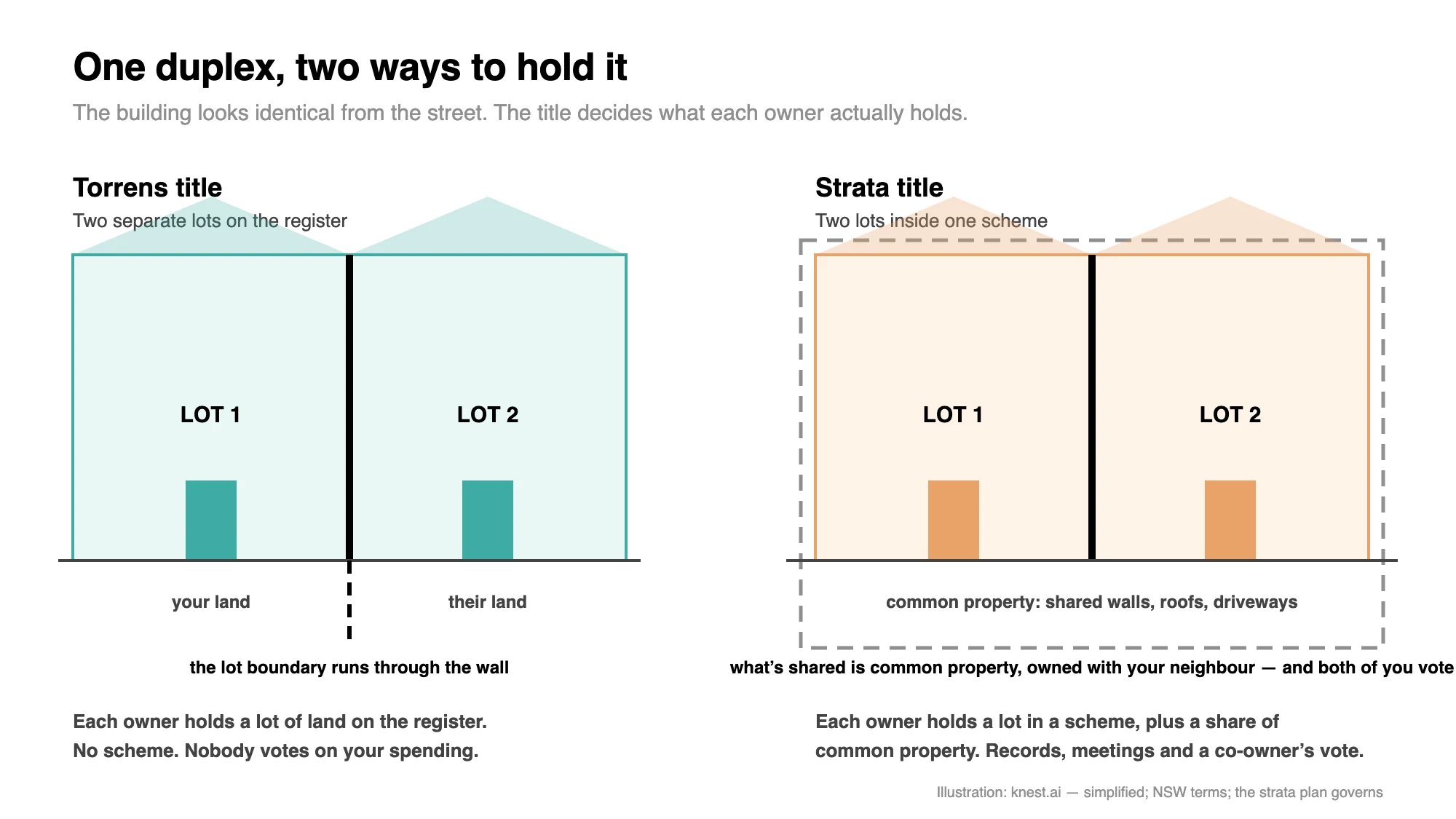
A Torrens-titled duplex on two separate lots has no owners corporation, no levies, no capital works fund. That does not remove any easement, agreement or other liability affecting the shared wall. In an NSW two-lot strata scheme, by contrast, the dividing wall is typically common property (NSW Fair Trading lists common walls among a scheme’s common property), and the strata plan settles it for a given scheme; our guide to what a duplex is covers that side in detail. Insurance becomes the main financial backstop, and you set the sum insured yourself, for half of a joined dwelling, harder to cost than a freestanding house.
Underinsurance punishes exactly this situation. Australia’s ASIC Moneysmart (2026) explains that averaging clauses “limit the insurer’s liability on claims to the proportion of the replacement value that has been insured”. Their worked example is a home costing $600,000 to rebuild but insured for $400,000. On a $15,000 repair claim, the insurer pays $10,000. You find the rest. Note what that example is: a partial claim, not a total loss. The point is that underinsurance can reduce partial claims as well as total losses, and for a separately insured duplex half that makes the adequacy of the sum insured worth checking.

What an inspection tells you, and what the title tells you
An inspection answers the condition question; the title documents answer the ownership question. A building and pest inspection can identify visible signs such as movement, moisture and cracking, but not who owns the wall or whether a registered right attaches to it. Condition and legal status are separate enquiries, and both checks are worth paying for.
Your conveyancer or solicitor covers the second one, examining the plan, the folio and any NSW section 88B instrument to determine what rights are recorded, or may apply.
Shared driveways raise a related title question. If the property relies on one, check what legal right, if any, supports the shared use rather than assuming long-standing use establishes it — how easements work covers that side.
The buyer takeaway. Check the wall twice: an inspection tells you about its physical condition, and the title documents tell you about ownership and registered rights. Neither should be inferred just because the wall is shared.
Frequently asked questions
Who owns a party wall in a duplex?
In New South Wales it depends on the plan. Where the boundary runs through the wall and the plan marks it a “party wall”, each owner holds the part on their land, and cross-easements let each rely on the whole wall for support — created by the plan (Conveyancing Act 1919 (NSW), s 88BB) or, for older lots, by the assurance (s 181B). Joint ownership of the wall is the strata arrangement, which is a different structure. South Australia and the ACT define a party wall by what it does rather than by severed ownership.
Does the Party Wall Act apply in Australia?
No. The Party Wall etc. Act 1996 applies in England and Wales. Its notice periods, appointed surveyors and binding awards have no effect in any Australian state or territory, which use registered easements, building-work consent regimes, planning consent or a dedicated boundaries Act instead.
Can my neighbour demolish their half of the wall?
In NSW, where a cross-easement exists, you are entitled to the continued existence of the portion needed to support your building. Western Australia goes further. It requires each owner’s consent before work affects the wall’s structure, waterproofing or acoustics, with a fine of $25,000 for a breach (Building Act 2011 (WA), s 79). That consent is not needed in two cases (Building Act 2011 (WA), s 79(1)(b)–(c)). One is where an order under section 86(2)(d) permits the work; the other is where the work is urgent to prevent imminent collapse of, or damage to, the wall.
Who pays to repair a shared wall in a duplex?
Among the regimes this guide compares, only Western Australia sets a statutory answer, splitting maintenance and repair equally between the owners either side unless they agree otherwise (Building Act 2011 (WA), s 89(2)). Five of Australia’s eight jurisdictions legislate for the cost of building the wall rather than repairing it, and New South Wales sets no cost rule in its party-wall provisions.
Is a party wall the same as common property?
No. Common property belongs to the scheme and is managed by the owners corporation, which is the strata situation covered in our duplex guide. In New South Wales, a party wall on two separate Torrens lots is privately owned, each side holding the part on its land. A cross-easement runs across the boundary where the NSW plan or the assurance created one. South Australia and the ACT frame it by what the wall does rather than by divided ownership.
A party wall is not something you can renovate your way out of. Read the plan before you sign, find out which rule your state applies, and in NSW look for the words “party wall”. That settles a question which otherwise surfaces years later at the worst possible moment, with a builder’s quote attached.
Your conveyancer reads the plan and the folio, and that settles who owns the wall. It doesn’t tell you what the land around it is exposed to. A knest.ai property report shows you the site risks: flood and bushfire exposure, zoning, power lines and noise.
View a sample reportSources
- NSW Land Registry Services, Registrar General’s Guidelines: Cross-easements for support of ‘party walls’, retrieved 2026-08-18, https://rg-guidelines.nswlrs.com.au/deposited_plans/easements_restrictions/cross_easements
- NSW Land Registry Services, Registrar General’s Guidelines: Extinguishment of a party wall, retrieved 2026-08-18, https://rg-guidelines.nswlrs.com.au/deposited_plans/easements_restrictions/cross_easements/extinguishment_party_wall
- NSW Land Registry Services, Registrar General’s Guidelines: Cross easements s181B Conveyancing Act 1919, retrieved 2026-08-18, https://rg-guidelines.nswlrs.com.au/land_dealings/dealing_requirements/transfers/crosseasements_s181
- Conveyancing Act 1919 (NSW), s 88BB, authorised current text, retrieved 2026-08-28 via the full-Act HTML view, https://legislation.nsw.gov.au/view/whole/html/inforce/current/act-1919-006
- Conveyancing Act 1919 (NSW), s 181B, authorised current text, retrieved 2026-08-28 via the full-Act HTML view, https://legislation.nsw.gov.au/view/whole/html/inforce/current/act-1919-006
- Building Act 1993 (Vic), Authorised Version No. 149, as at 30 July 2026, ss 100 and 158, retrieved 2026-08-18, https://content.legislation.vic.gov.au/sites/default/files/2026-07/93-126aa149-authorised.pdf
- Land Title Act 1994 (Qld), current as at 1 August 2025, ss 115M and 115N, retrieved 2026-08-18, https://www.legislation.qld.gov.au/view/pdf/inforce/current/act-1994-011
- Building Act 2011 (WA), Version 01-h0-00 as at 30 June 2021, ss 75, 79 and 89, retrieved 2026-08-18, https://www.legislation.wa.gov.au/legislation/statutes.nsf/main_mrtitle_12333_homepage.html
- Planning, Development and Infrastructure Act 2016 (SA), ss 3 and 147, authorised version current at 15 January 2026, retrieved 2026-08-28 (Web Archive capture, 30 July 2026, of the authorised PDF), https://www.legislation.sa.gov.au/lz?path=%2Fc%2Fa%2Fplanning+development+and+infrastructure+act+2016
- Legal Services Commission of South Australia, South Australian Law Handbook: Building work affecting other land, retrieved 2026-08-18, https://www.lawhandbook.sa.gov.au/ch28s02s06s03.php
- Building Act 2016 (Tas), s 56, authorised version as at 11 June 2026, retrieved 2026-08-18, https://www.legislation.tas.gov.au/view/whole/html/inforce/current/act-2016-025
- Common Boundaries Act 1981 (ACT), Republication No. 23, effective 6 December 2025, ss 27 and 28, retrieved 2026-08-18, https://www.legislation.act.gov.au/a/1981-39/current/pdf/1981-39.pdf
- Building Act 1993 (NT), as in force at 10 February 2026, ss 19 and 97, retrieved 2026-08-18, https://legislation.nt.gov.au/Legislation/BUILDING-ACT-1993
- Party Wall etc. Act 1996 (United Kingdom), applying in England and Wales, retrieved 2026-08-18, https://www.legislation.gov.uk/ukpga/1996/40/contents
- ASIC Moneysmart, Underinsurance: what it is and how to avoid it, last updated 18 August 2026, retrieved 2026-08-18, https://moneysmart.gov.au/home-insurance/underinsurance-what-it-is-and-how-to-avoid-it
- knest.ai analysis of Australian Google results for the term party wall, using Ahrefs SERP overview, August 2026, retrieved 2026-08-18, https://ahrefs.com/keywords-explorer
Daniel Ryan, Editor, Buyer Guides & Property, knest.ai
General information only. This article is general information for Australian home buyers. It isn’t personal legal, financial, credit or tax advice, and it isn’t a property valuation. Party-wall and easement rules differ by state and change over time. Check your own situation with a licensed conveyancer or solicitor in the relevant state. knest.ai is an AI property-intelligence platform that supports buyer judgment. It isn’t a conveyancer, a solicitor or a legal service, and it doesn’t replace one. More about who we are and how we work: About knest.ai, and where our figures come from: Data sources.