
knest.ai • Property intelligence for home buyers
What Is a Duplex in Australia? A Buyer’s Guide
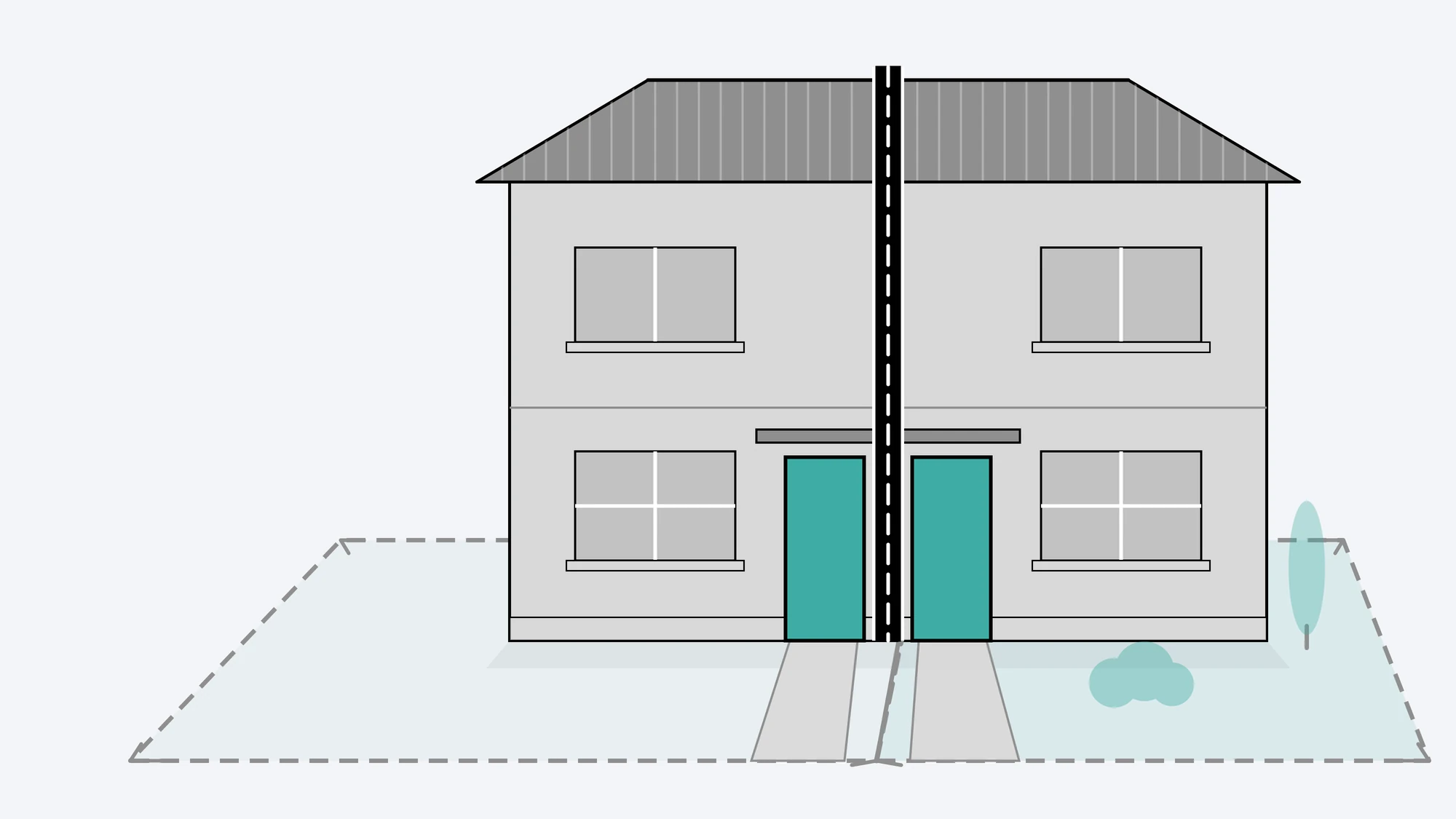
A duplex is two homes built on one block of land, usually sharing a wall down the middle. That’s the plain answer, and for most buyers it’s enough to know before an inspection.
Here’s the part the listing won’t tell you. No Australian planning instrument we could verify defines the word “duplex”. The word doesn’t appear anywhere in New South Wales’ statutory planning dictionary; the closest the planning department gets is calling dual occupancies “often known as duplexes or semis”. And what the word describes shifts depending on which state or territory you’re standing in. So when an agent says “duplex”, they’re using a market word, not a legal one, and you can’t tell from the word alone what you’d actually own.
(If you arrived here looking for duplex printing, a duplex apartment or a duplex kidney, this isn’t that. This is the Australian property sense.)
- A duplex is usually two dwellings on one lot. In New South Wales planning law the term is “dual occupancy”, and the department notes these are “often known as duplexes or semis”.
- “Duplex” isn’t a defined planning term in any Australian state or territory we could verify; Queensland defines it in a building code, which is a different rulebook.
- Queensland’s dual occupancy definition is wider than New South Wales’, and can cover two dwellings on separate lots sharing common property.
- In New South Wales, Fair Trading says two-lot strata schemes “include duplexes”, so a duplex that has been strata-subdivided has an owners corporation whatever you’ve been told.
- If the two homes share a wall, a NSW two-lot strata scheme can’t opt out of one shared building insurance policy. That ties you to your neighbour’s decisions.
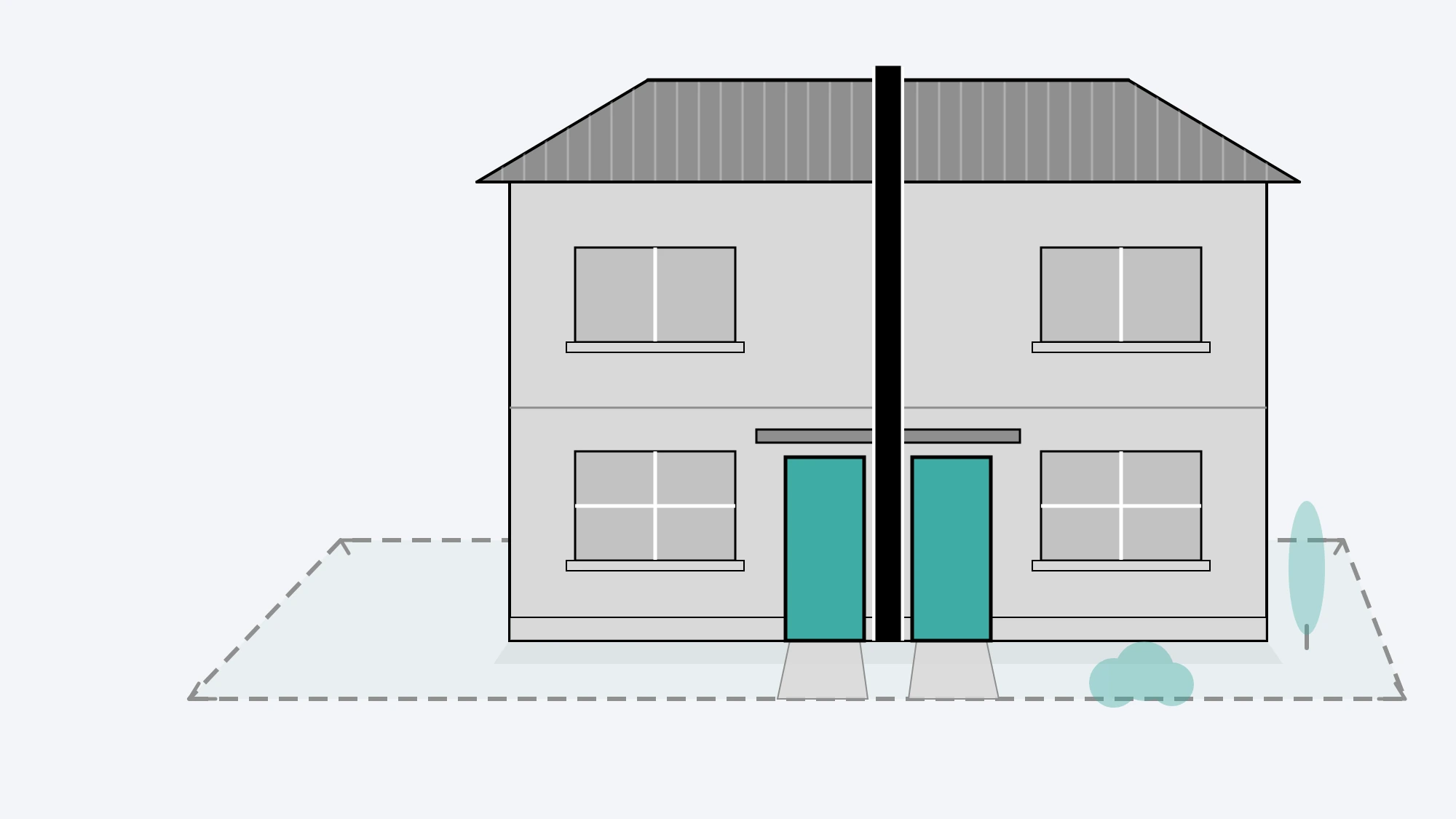
What actually counts as a duplex?
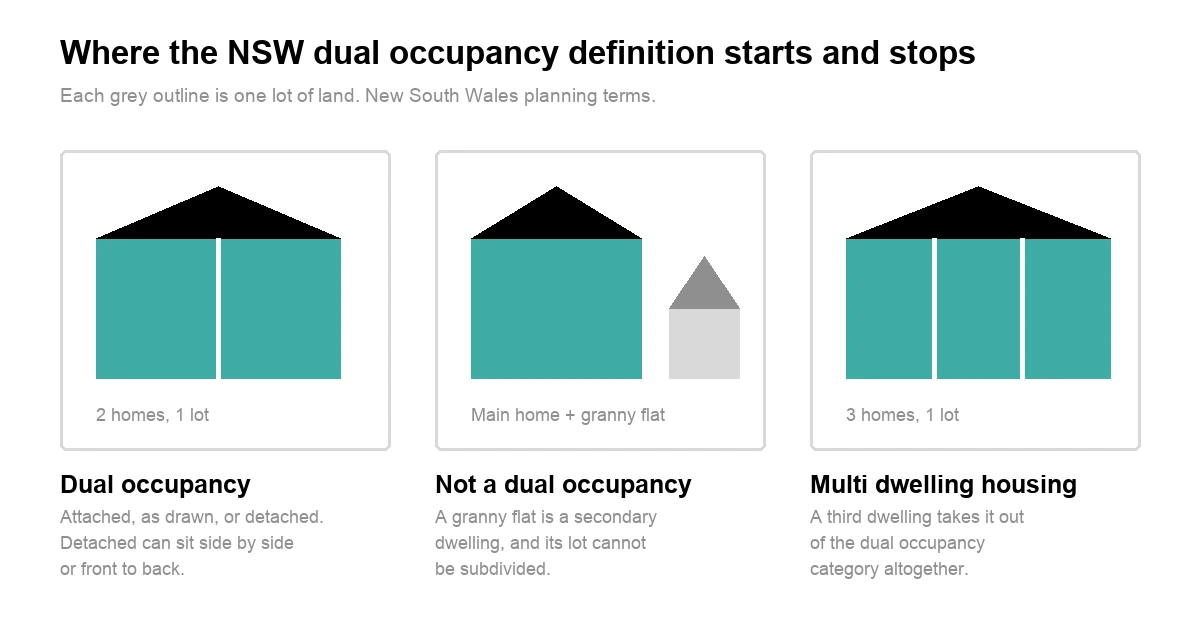
Two homes, one block. The New South Wales Department of Planning, Housing and Infrastructure (2025) puts it in one line: “Dual occupancies are 2 homes built on one lot of land. The homes can be either attached or detached”.
The version most people picture is the attached one. That’s the shared-wall building, and the department (2025) describes it precisely: “An attached dual occupancy consists of 2 dwellings on one lot of land that are attached to each other. They are characterised by the fact that the 2 dwellings share a common wall (also known as a partition wall) in a semi-detached configuration”.
But a duplex doesn’t have to share a wall. A detached dual occupancy is “2 dwellings built on one lot that are not attached” (NSW Department of Planning, Housing and Infrastructure, 2025). Two separate houses, one lot. That matters more than it sounds, and we’ll come back to it when we get to insurance.
Planning law doesn’t define the word, and the ABS doesn’t count it as its own category either. The closest 2021 Census category bundles duplexes with semis, terraces and townhouses: “Semi-detached, row or terrace house, townhouse etc”, which covered 1,168,860 occupied private dwellings, or 12.6% of the national total (Australian Bureau of Statistics, 2021).
The ABS doesn’t count duplexes as their own category. The teal bar is “Semi-detached, row or terrace house, townhouse etc”, which bundles duplexes together with terraces and townhouses, so treat it as the neighbourhood a duplex lives in rather than a duplex count.
Why does “duplex” mean different things across Australia?
Because “duplex” is mainly an everyday property term, while planning systems often use terms such as “dual occupancy”. And the definitions vary by jurisdiction.
New South Wales calls it a dual occupancy
The planning term in New South Wales is “dual occupancy”. The department (2025) is explicit about the gap between that and everyday speech: “Dual occupancies are often known as duplexes or semis”. Note what that sentence is doing. It’s translating, not defining. The word “duplex” is being acknowledged as the thing people call it.
Queensland’s version is wider
Queensland uses “dual occupancy” too, and Brisbane City Council states directly that “Dual occupancy is the term used in Brisbane City Plan 2014 to refer to duplex developments”. But the Queensland definition reaches further than the New South Wales one. It covers “the residential use of premises containing 2 dwellings on one lot (whether or not attached), or 2 dwellings on separate lots that share common property” (Brisbane City Council).
Read that second limb again. In Queensland the category can span two separate lots, provided they share common property. In New South Wales, a dual occupancy is two dwellings on one lot. Same term, different reach.
Queensland is also the only place we found the word itself defined in a government instrument. The Queensland Development Code’s part MP 1.3, “Design and Siting Standard for Duplex Housing”, defines it in one line: “Duplex means a building containing not more than 2 attached dwellings” (Queensland Government, 2010). Three things keep that in perspective: it is a building code standard rather than a planning definition, its application depends on a local government resolution, and the current version commenced in 2010, referencing the Sustainable Planning Regulation 2009.
Victoria and WA use different planning language
Terminology changes again outside New South Wales and Queensland.
Victoria doesn’t run a duplex category in its residential provisions. The state’s own practice note frames residential assessment by count: “one dwelling on a lot or small second dwelling” under clause 54, and “two or more dwellings on a lot” under clause 55 (Victorian Government, PPN27). Neither “duplex” nor “dual occupancy” appears in it.
Western Australia’s Residential Design Codes define their own categories. A grouped dwelling is “one of a group of two or more dwellings on the same lot such that no dwelling is placed wholly or partly vertically above or below another” (with a narrow topography exception), and the definition reaches “a dwelling in a strata titles scheme with common property” (Government of Western Australia, Department of Planning, Lands and Heritage, 2024). The word “duplex” appears nowhere in the 150-page code.
The other four jurisdictions each run their own word too. Tasmania’s State Planning Provisions set “multiple dwellings” at “2 or more dwellings on a site”. The ACT’s Territory Plan defines “dual occupancy housing” as two dwellings on land originally used for one, and classes it as multi-unit housing, which in the ACT covers “more than one dwelling”. The Northern Territory’s planning scheme defines “dwelling-group” around a dwelling that is “one of a group of two or more dwellings on the same site”, none stacked above another, with the same narrow topography exception. And South Australia’s 2025 category, “co-located housing”, covers “a group of 2 or more dwellings” on community-titled allotments inside a dedicated overlay (PlanSA, 2025).
| Jurisdiction | What the planning system calls it | Does government use “duplex”? | Source |
|---|---|---|---|
| NSW | Dual occupancy (attached or detached) | Only as an aside: “often known as duplexes or semis” | NSW Dept of Planning, Housing and Infrastructure |
| QLD | Dual occupancy, and wider than NSW’s | Yes: defined in the building code (QDC MP 1.3) | Brisbane City Council · Queensland Government |
| VIC | No duplex category in its residential provisions; assessed by count, “two or more dwellings on a lot” (clause 55) | Not in the state practice note | Victorian Government (PPN27) |
| WA | Grouped dwelling: 2+ dwellings on the same lot, generally none stacked above another | Not in the Residential Design Codes | WA Dept of Planning, Lands and Heritage |
| SA | Co-located housing: a 2025 category for 2+ community-titled dwellings in a dedicated overlay | Not in the PlanSA guide | Government of South Australia (PlanSA) |
| TAS | Multiple dwellings: “2 or more dwellings on a site” | Not in the State Planning Provisions | Tasmanian Planning Scheme (SPP) |
| ACT | Dual occupancy housing, a type of multi-unit housing (more than one dwelling) | Not in the Territory Plan Dictionary | ACT Territory Plan 2023 |
| NT | Dwelling-group: one of 2+ dwellings on the same site, generally none stacked above another | Not in the Scheme’s definitions | NT Planning Scheme 2020 |
Each row is drawn from that jurisdiction’s own planning document, listed in Sources. Two caveats: the WA and Tasmanian rows were verified on the 2024 consolidations of their instruments, and South Australia’s co-located housing is a category inside a dedicated overlay rather than a general duplex term. Instruments change with amendments, so confirm the current wording for a specific address with the state planning authority.
The practical upshot: the word on the listing tells you the shape of the building and almost nothing about your legal position. For that you need the title, which we come to below, and for the dual occupancy side of the terminology we’ve gone deeper in dual occupancy explained.
How many lots, and how many homes?
The distinction that actually matters is how many lots the land has been cut into, and how many dwellings are on it. It helps to hold three questions apart: what the building looks like (its form), how the land is divided (lots), and what you would legally own (the title). This section is about the middle one; title comes later in this guide.
The baseline is the case the first section defined: a dual occupancy, attached or detached, is two homes on one lot. New South Wales’ Standard Instrument for local environmental plans draws the same line in its dictionary: “dual occupancy (attached) means 2 dwellings on one lot of land that are attached to each other”, with a detached twin on the same single lot (both definitions exclude a secondary dwelling). Two homes, one lot, nothing subdivided.
In New South Wales planning guidance, what separates a semi from an attached dual occupancy is the lot boundary. The department (2025) describes semis as “side-by-side dual occupancies that have been subdivided down the middle, so each house sits on its own lot”. Same building, two lots instead of one.
The statutory dictionary agrees, in one line: “semi-detached dwelling means a dwelling that is on its own lot of land and is attached to only one other dwelling”.
Townhouses and villas are a different conversation. The same statutory dictionary sets “multi dwelling housing” at “3 or more dwellings (whether attached or detached) on one lot of land, each with access at ground level”, and excludes residential flat buildings from it. Penrith City Council (2025) treats three or more dwellings as multi-unit housing, which “can take the form of villas, town houses, apartments, or residential flat buildings”. Note the wording: townhouse and villa are housing forms that can appear inside larger multi-dwelling developments. Dwelling count alone doesn’t define them.
| Dwellings | Lots | What this can indicate |
|---|---|---|
| 2 | 1 | Attached or detached dual occupancy; nothing has been subdivided |
| 2 | 2 | A semi-detached pair or a subdivided duplex; each house sits on its own lot |
| 3+ | varies | Multi-unit housing; townhouse and villa are forms it can take |
A visual guide to dwelling and lot structure, not a legal classification test. The dual-occupancy, semi-detached and three-or-more definitions come from New South Wales’ statutory Standard Instrument dictionary; local planning controls and definitions may vary.
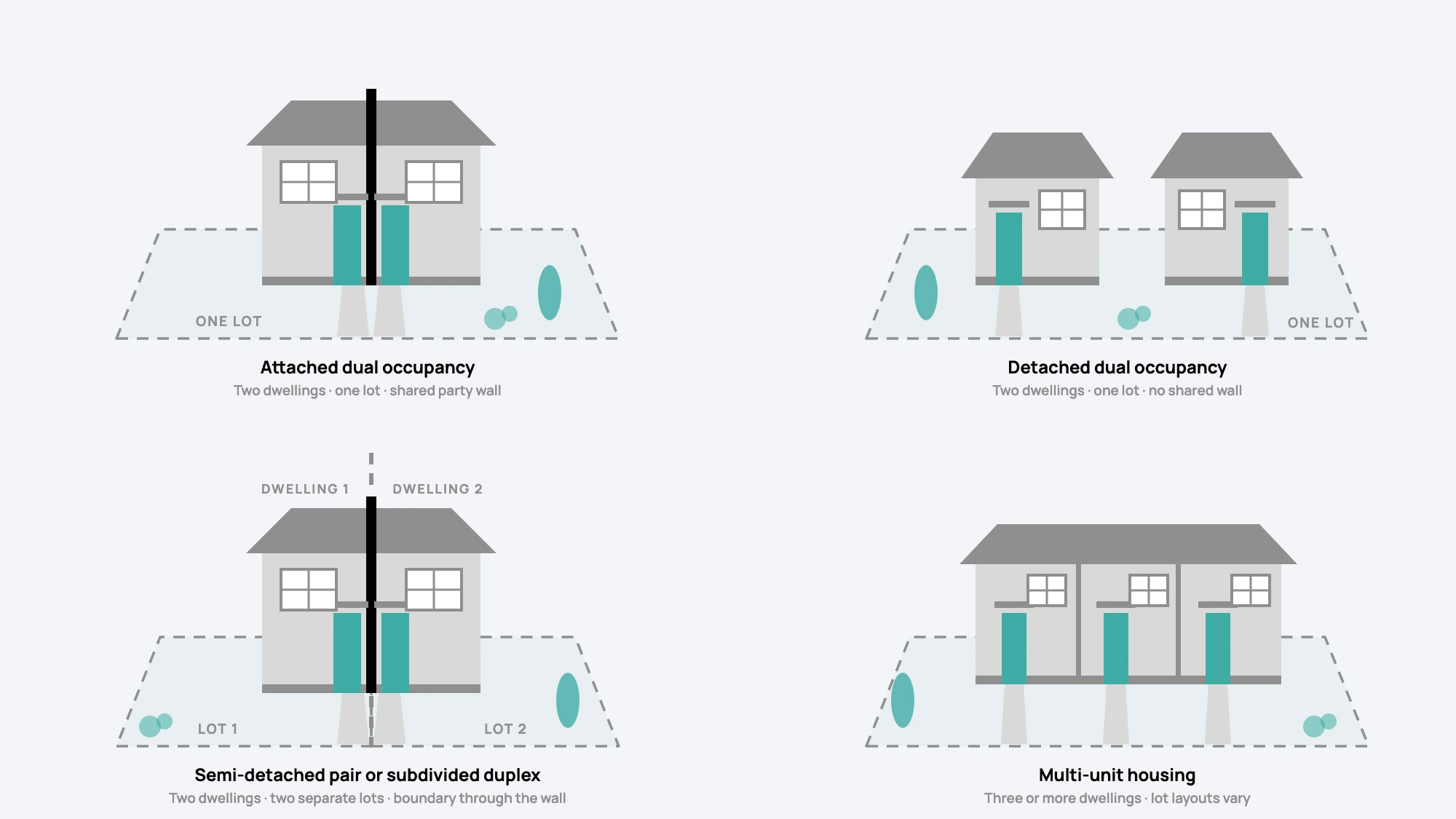
We’ve compared all four side by side in duplex vs townhouse, semi and villa.
What title are you actually buying?
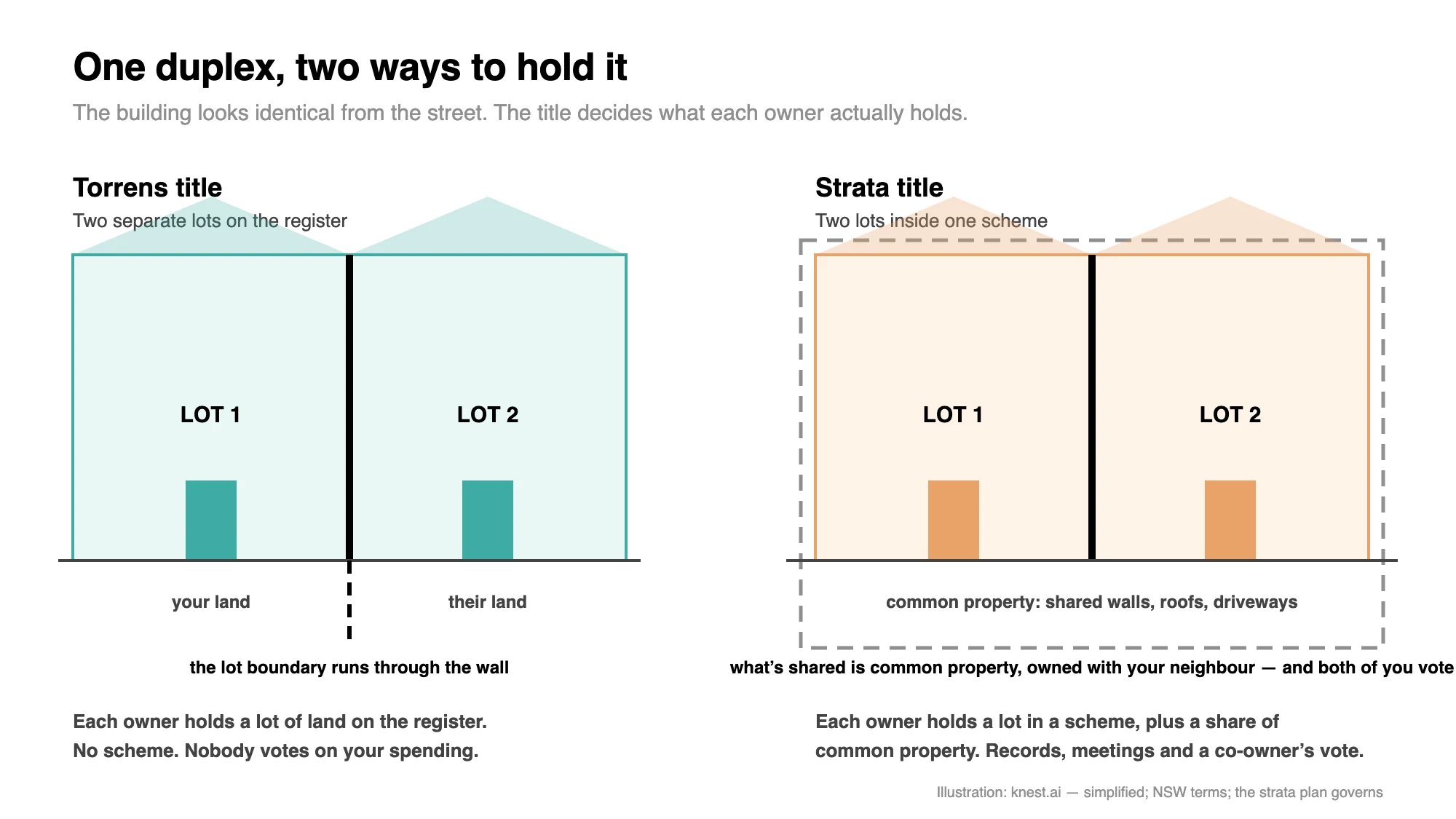
Two duplexes can look identical from the street and be completely different purchases. The difference is the title.
Under the Torrens system “there is a single title document, the Certificate of Title, for each piece of land” (State Library of New South Wales). If your interest is freehold, “it means you are the owner, or registered proprietor, of the land” (State Library of New South Wales). One parcel, one title, your name on it.
Strata works differently. “Under strata title you do not own the whole property but only your ‘lot’. The ‘common property’ is owned and managed by the property’s owners corporation” (State Library of New South Wales). And in New South Wales strata is the usual arrangement for this kind of housing. The State Library of New South Wales calls it “the most common form of ownership for home units, apartments, town houses, villas and duplexes”.
NSW Fair Trading (2026) describes a strata scheme as “a building or group of buildings that has been divided into ‘lots’ such as an apartment, townhouse or villa”. It also confirms the reach. Strata law applies to “strata properties such as apartments, townhouses, villas, and many duplexes” (2026).
Here’s the detail worth carrying into an inspection. In a strata scheme, the things you might assume are yours often aren’t. Fair Trading (2026) lists common property as including “driveways, swimming pools, gardens” and “common walls, external doors, roofs, pipes, electrical wiring”. The driveway you’d park in and the wall between you and your neighbour can both be common property. Worth asking whether the driveway also carries a registered right of way, which is a separate thing again. We’ve explained easements and rights of way in easements on the title.
Torrens and strata exist across Australia, but each state has its own legislation and its own land registry, so the wording above is the New South Wales version. For the full comparison and what to check on the title, see Torrens or strata title duplex.
The duplex body corporate nobody mentions
If you’re told a duplex has “no body corporate”, treat that as a claim to check rather than a feature of the property. One note on wording: New South Wales law calls it an owners corporation, so that is the term we use for the New South Wales rules below.
NSW Fair Trading (2022) is direct about it. “Two-lot strata schemes are those limited to only two lots. These include duplexes and houses that are divided into two lots”. So a duplex can, in law, be a two-lot strata scheme. That is why “no body corporate” is something to verify against the title and strata records, rather than take at face value. In New South Wales, a duplex split into two Torrens lots isn’t a strata scheme at all, so the owners corporation rules below aren’t the ones that apply. The title tells you which situation you’re in.
And things do follow, even at two lots. NSW Fair Trading (2022) states that “All two lot schemes need to complete their annual strata reporting”, and that “the annual strata report needs to be completed within 3 months of the AGM”. The scheme must also “nominate at least one emergency services contact”. An annual general meeting, an annual report on a deadline, a named contact. That’s a small administrative load rather than a crushing one, but it isn’t nothing, and it isn’t “no body corporate”.
There is a narrow escape hatch on the money side. In New South Wales, Fair Trading says a two-lot scheme can resolve not to keep a capital works fund. That takes a unanimous vote, and only works where the scheme meets a physical test we’ll come to next.
The insurance problem that comes with a shared wall
This is the part of buying a duplex that costs people money afterwards, and it’s the part almost nobody explains. The following is the New South Wales position, because insurance sits inside state strata law. And it turns on two conditions together: the duplex sits in a two-lot strata scheme, and the two homes are attached. One without the other, and this section works differently.
The detachment test
A two-lot strata scheme can opt out of holding building insurance, but only under strict conditions. NSW Fair Trading (2026) sets three conditions. The buildings must be “physically detached”, and “no buildings or parts of a building are located outside the two lots”. The owners must then pass a “unanimous vote that they don’t need to get building insurance”. Only then may they “choose to get individual building insurance instead”.
Read that against the definition we started with. An attached duplex shares a common wall. It is not physically detached. So for the classic shared-wall duplex in a two-lot scheme, that opt-out isn’t available, and the scheme holds one building insurance policy covering both homes.
What one shared policy means in practice
It means you and the person on the other side of the wall are tied together on decisions you’d normally make alone. One policy means one insurer, one sum insured, one set of decisions about what gets repaired and by whom. Disagreement over the cause, scope or cost of works can make a two-owner scheme more complicated to claim on than a standalone house.
The obligations are real too. Strata building insurance has to cover “replacing or reinstating the building to as-new condition”, “paying architects or other professionals needed to repair the building” and “removing debris” (NSW Fair Trading, 2026). And on keeping the sum insured current, Fair Trading’s recommendation: “You should get a new building valuation every 2 to 5 years by contracting a qualified valuer” (2026).
The strata rules above stop at strata. For a duplex held on Torrens title — a single title over both homes, or two separate lots sharing a wall, which are different situations — don’t assume any of this applies. Check the insurance position against the title, the contract, the current policy and any registered rights over the shared structure.
Questions worth asking before you sign:
- What exactly does the current building policy insure, and who is the named insured?
- Is the building insured under one policy or two, and who holds it?
- Is the driveway common property?
- What happens to a claim if the other owner disputes the scope of work?
The shared wall raises its own set — who owns it, and who pays when it cracks. See our guide to party walls in Australia.
Can someone build a duplex next door? What the NSW rules changed
If you’re buying a house in New South Wales, this affects the block beside yours as much as your own.
What actually changed
The change is the NSW Low and Mid-Rise Housing Policy, which sits inside the State Environmental Planning Policy (Housing) 2021 and arrived in two stages (NSW Department of Planning, Housing and Infrastructure, 2025).
The first stage started on 1 July 2024, covering dual occupancies and semi-detached homes. Dual occupancy is now “permitted with consent in R2 zones state-wide”, and may also be permitted in other zones depending on the council’s Local Environmental Plan (NSW Department of Planning, Housing and Infrastructure, 2025). “State-wide” comes with real exceptions, which are below.
The second stage started on 28 February 2025. It introduced further permissibility and new development standards, but only within designated low and mid-rise housing areas, not across R2 state-wide (NSW Department of Planning, Housing and Infrastructure, 2025).
“Permitted with consent” is the phrase to hold onto. It is not automatic approval. The department (2025) confirms that most development of this kind will continue to be assessed by the relevant council as a local development application. The zoning allows the use; approval remains a process the specific proposal has to pass.
Where the policy doesn’t apply
The “state-wide” framing comes with carve-outs, and they’re substantial. The department (2025) excludes “the Hawkesbury, Blue Mountains and Wollondilly local government areas”. Its reason is “high-risk hazards that impact these local government areas, including bushfire, flooding and limited evacuation routes”. It also excludes “the Bathurst local government area” because “there is no suitable R2 land”.
Land is excluded too, not just whole council areas. The department’s carve-outs cover:
- “bushfire prone land, certain flood prone lands, coastal wetlands, littoral rainforest and coastal vulnerability areas”;
- “land near to dangerous goods pipelines”;
- “land subject to high aircraft noise impacts”; and
- “land that constitutes or contains a heritage item” (NSW Department of Planning, Housing and Infrastructure, 2025).
One reading to avoid: excluded from the policy is not the same as a duplex being banned there. It means the state policy’s permission doesn’t reach that land; what the council’s own plan allows is a separate question, checked for the specific address.
Councils still matter in the other direction as well. Northern Beaches Council, for one, applies its own minimum site area to dual occupancy under its local environmental plan. So the state sets the baseline permissibility and the council still sets much of the detail — though inside designated low and mid-rise housing areas, the policy’s non-discretionary standards can override a stricter council standard (NSW Department of Planning, Housing and Infrastructure, 2025). Either way, the detail is where a specific block gets decided.
The takeaway for a buyer: R2 zoning is no longer a reason to assume the block next door stays single-house forever, and zoning permission is only the first check. Whether a specific block could take a duplex is its own question, with its own numbers, and we’ve worked through it in check a block’s duplex potential.
Buying a duplex: what should you check?
Start with the title, because it decides most of the rest. There’s a real difference between buying one lot of a two-lot scheme, one half of a subdivided semi, and a whole building on a single title. It changes what you own, what you insure, and what you can sell later.
Then work outward. Is there an owners corporation, regardless of what the listing says? The insurance questions are in the section above. Is the property being sold as subdividable? In New South Wales a subdivision certificate is a separate step, obtained “after subdivision works are completed”. It is also the instrument that “authorises the registration of the subdivision within NSW Land Registry Services” (NSW Planning Portal).
Your conveyancer or solicitor confirms the legal facts on the title and in the contract. The physical questions around the block, including what the zoning would allow next door, are yours to check. And if you’re weighing buying an established duplex against building one, we’ve set out how much it costs to build a duplex separately.
The short version
A duplex is two homes on one block, and that’s about as far as the word gets you. It isn’t a defined planning term in any state or territory we could verify, and it means something wider in Queensland than in New South Wales. Victoria and Western Australia use different planning language again.
What decides your purchase is the title, not the label. Get it read before you’re committed. In New South Wales, assume there is an owners corporation until the title says otherwise. And if it’s a two-lot strata scheme with a shared wall, expect one shared insurance policy too.
A knest.ai property report shows you the site risks a listing leaves out: flood and bushfire exposure, zoning, power lines and noise. Zoning is also what decides whether a duplex could go up next door.
View a sample reportFrequently asked questions
Is a duplex the same as a dual occupancy?
In New South Wales, effectively yes. The NSW Department of Planning, Housing and Infrastructure notes that dual occupancies are “often known as duplexes or semis”, so “dual occupancy” is the planning word and “duplex” is the market word. Brisbane City Council states a wider Queensland definition, covering two dwellings on separate lots that share common property. Our dual occupancy guide covers the difference in full.
Does a duplex have a body corporate?
In New South Wales, it depends on the title: a strata-titled duplex has an owners corporation, and NSW Fair Trading counts “many duplexes” among strata properties. Two-lot strata schemes “include duplexes and houses that are divided into two lots”, and all two-lot schemes must complete annual strata reporting within three months of the AGM and nominate an emergency services contact. Treat “no body corporate” as a claim to verify against the title.
Can you buy just one half of a duplex?
In New South Wales, it depends on whether the land has been divided. If the building sits on one lot with one title, there’s one property to buy. If it’s been subdivided into two lots, or is a two-lot strata scheme, each side can be bought separately. The title tells you which.
Why does a shared wall mean one insurance policy?
In New South Wales, NSW Fair Trading says a two-lot strata scheme can only opt out of shared building insurance where the buildings are “physically detached”. A duplex that shares a wall fails that test, so the scheme holds one policy across both homes and repair decisions become joint ones.
Could someone build a duplex next to me?
The NSW Department of Planning, Housing and Infrastructure says dual occupancy is permitted with consent in R2 zones state-wide, so it’s possible in many areas. It still needs a development application assessed by the council. Several local government areas are excluded, along with bushfire-prone, flood-prone, heritage and aircraft-noise affected land.
Sources
- NSW Department of Planning, Housing and Infrastructure, Unpacking low-rise housing, 21 February 2025, retrieved 2026-08-11, https://www.planning.nsw.gov.au/policy-and-legislation/housing/low-and-mid-rise-housing-policy/unpacking-low-rise-housing
- NSW Department of Planning, Housing and Infrastructure, Summary of key provisions, 21 March 2025, retrieved 2026-08-11, https://www.planning.nsw.gov.au/policy-and-legislation/housing/low-and-mid-rise-housing-policy/summary-of-key-provisions
- NSW Department of Planning, Housing and Infrastructure, Frequently asked questions, Low and Mid-Rise Housing Policy, 17 December 2025, retrieved 2026-08-11, https://www.planning.nsw.gov.au/policy-and-legislation/housing/low-and-mid-rise-housing-policy/frequently-asked-questions
- NSW Department of Planning, Housing and Infrastructure, Low and Mid-Rise Housing Policy, 16 July 2025, retrieved 2026-08-11, https://www.planning.nsw.gov.au/policy-and-legislation/housing/low-and-mid-rise-housing-policy
- NSW Planning Portal, Post Consent Certificates, undated, retrieved 2026-08-11, https://www.planningportal.nsw.gov.au/development-and-assessment/post-consent-certificates
- NSW Government (Fair Trading), Buying a strata property, 1 April 2026, retrieved 2026-08-11, https://www.nsw.gov.au/housing-and-construction/strata/buying-a-strata-property
- NSW Government (Fair Trading), Managing strata finances and insurance, 22 June 2026, retrieved 2026-08-11, https://www.nsw.gov.au/housing-and-construction/strata/serving-on-a-committee/finances-insurance
- NSW Fair Trading, How two-lot strata schemes can easily tackle reporting, 22 August 2022, retrieved 2026-08-11, https://www.nsw.gov.au/departments-and-agencies/fair-trading/news/two-lot-strata-schemes
- State Library of New South Wales, Property rights and neighbours, in Neighbours and the Law, undated, retrieved 2026-08-11, https://www.sl.nsw.gov.au/find-legal-answers/books-online/neighbours-and-law/property-rights-and-neighbours
- Penrith City Council, Common Development Types, 3 September 2025, retrieved 2026-08-11, https://www.penrithcity.nsw.gov.au/building-development/development/common-development-types
- Northern Beaches Council, Low and Mid Rise Housing Policy, undated, retrieved 2026-08-11, https://www.northernbeaches.nsw.gov.au/planning-and-development/planning-future/planning-growth/housing/low-and-mid-rise-housing-policy
- Australian Bureau of Statistics, 2021 Australia, Census All persons QuickStats, 2021 Census, retrieved 2026-08-11, https://www.abs.gov.au/census/find-census-data/quickstats/2021/AUS
- Brisbane City Council, Dual occupancy, planning and building requirements, undated, retrieved 2026-08-11, https://www.brisbane.qld.gov.au/building-and-planning/getting-started-on-your-project/residential-projects/dual-occupancy
- Business Queensland (Queensland Government), Queensland Development Code, 3 August 2026, retrieved 2026-08-11, https://www.business.qld.gov.au/industries/building-property-development/building-construction/laws-codes-standards/queensland-development-code
- Queensland Government, Queensland Development Code MP 1.3 (Design and Siting Standard for Duplex Housing), commenced 26 March 2010, retrieved 2026-08-27, https://www.housing.qld.gov.au/__data/assets/pdf_file/0014/4307/mp1-3.pdf
- NSW Government, Standard Instrument—Principal Local Environmental Plan, Dictionary, in force, retrieved 2026-08-27, https://legislation.nsw.gov.au/view/html/inforce/current/epi-2006-155a
- Victorian Government, Planning Practice Note 27: Understanding the residential development provisions, retrieved 2026-08-27, https://www.planning.vic.gov.au/guides-and-resources/guides/planning-practice-notes/understanding-the-residential-development-provisions
- Government of Western Australia (DPLH), Residential Design Codes Volume 1, March 2024 version, A1 Definitions, retrieved 2026-08-27, https://www.wa.gov.au/system/files/2024-07/r-codes-volume-1-2024-mar2024.pdf
- Government of South Australia (PlanSA), Co-located Housing How to Guide, September 2025, retrieved 2026-08-27, https://plan.sa.gov.au/__data/assets/pdf_file/0005/1551578/How-to-Guide-Co-located-Housing.pdf
- Tasmanian Planning Scheme, State Planning Provisions, consolidation effective 26 June 2024, retrieved 2026-08-27, https://www.stateplanning.tas.gov.au/__data/assets/pdf_file/0003/543036/Tasmanian-Planning-Scheme-State-Planning-Provisions-effective-26-June-2024.PDF
- ACT Government, Territory Plan 2023 (NI2023-540), Dictionary, retrieved 2026-08-27, https://www.legislation.act.gov.au/ni/2023-540/
- Northern Territory Government, NT Planning Scheme 2020, Schedule 2: Definitions, retrieved 2026-08-27, https://nt.gov.au/__data/assets/pdf_file/0008/914930/nt-planning-scheme-schedule-two-definitions.pdf
Daniel Ryan, Editor, Buyer Guides & Property, knest.ai
General information only. This article is general information for Australian home buyers. It isn’t personal legal, financial, credit or tax advice, and it isn’t a property valuation. Planning and strata rules differ by state and change over time. Check your own situation with a licensed conveyancer or solicitor in the relevant state. knest.ai is an AI property-intelligence platform that supports buyer judgment. It isn’t a conveyancer, a solicitor or a legal service, and it doesn’t replace one.
Recommended for you
Torrens Title vs Strata Title: What Duplex Buyers Check
Can You Build a Duplex on This Block? How Buyers Check Duplex Potential
What Is a Party Wall in Australia? Who Owns It, Who Pays
Dual Occupancy Explained (and How It Differs From a Duplex)
Duplex vs Townhouse vs Semi vs Villa: What Actually Differs for Buyers